/ 01
Binary & Quantized Networks
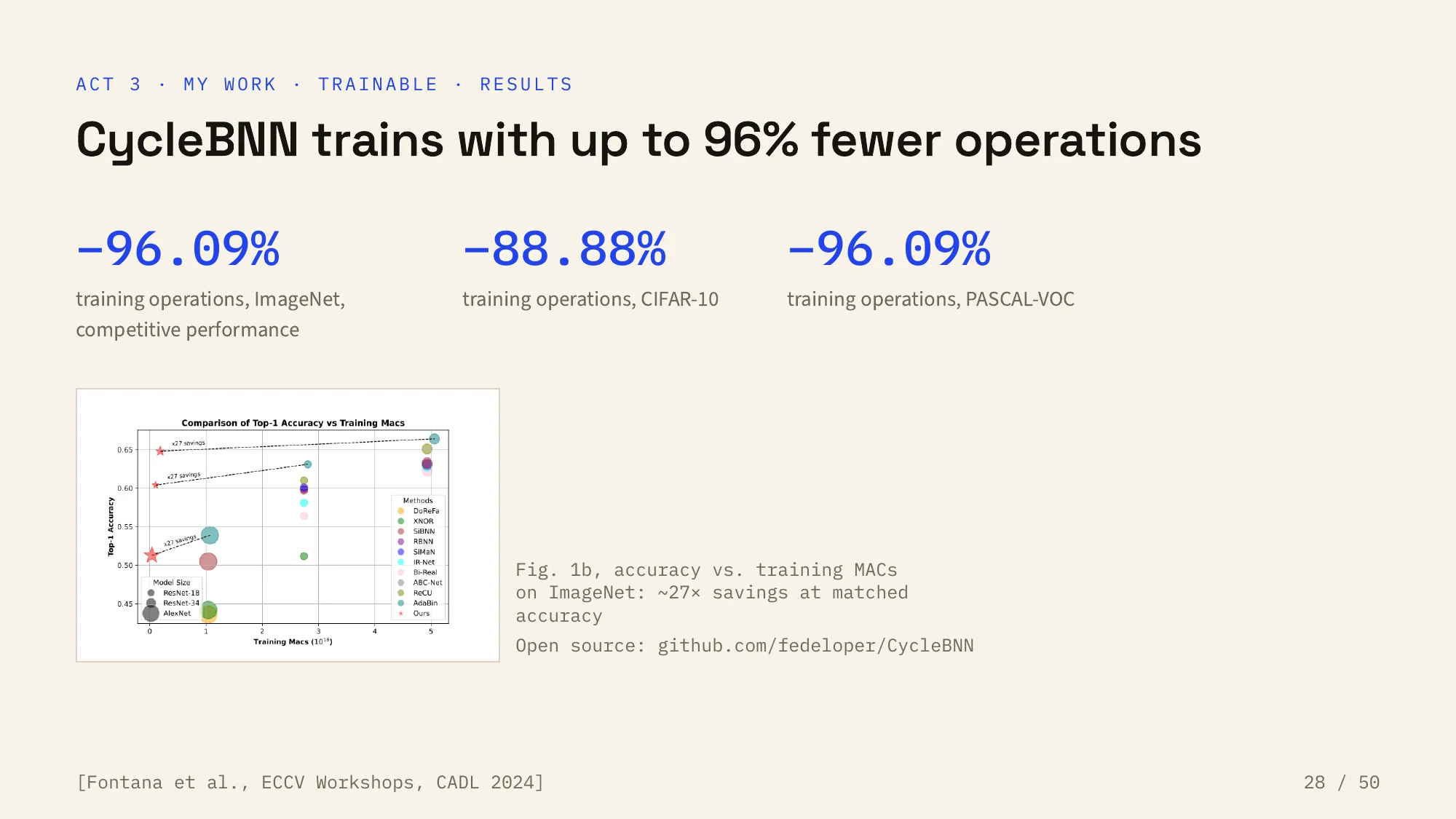
Training networks that abandon floating point almost entirely — cyclic-precision schedules (CycleBNN), binary backbones for real-time perception, and quantization that survives deployment.
Postdoctoral Researcher · Sapienza University of Rome
Efficient & Trustworthy Deep Learning · Computer Vision Laboratory, Sapienza
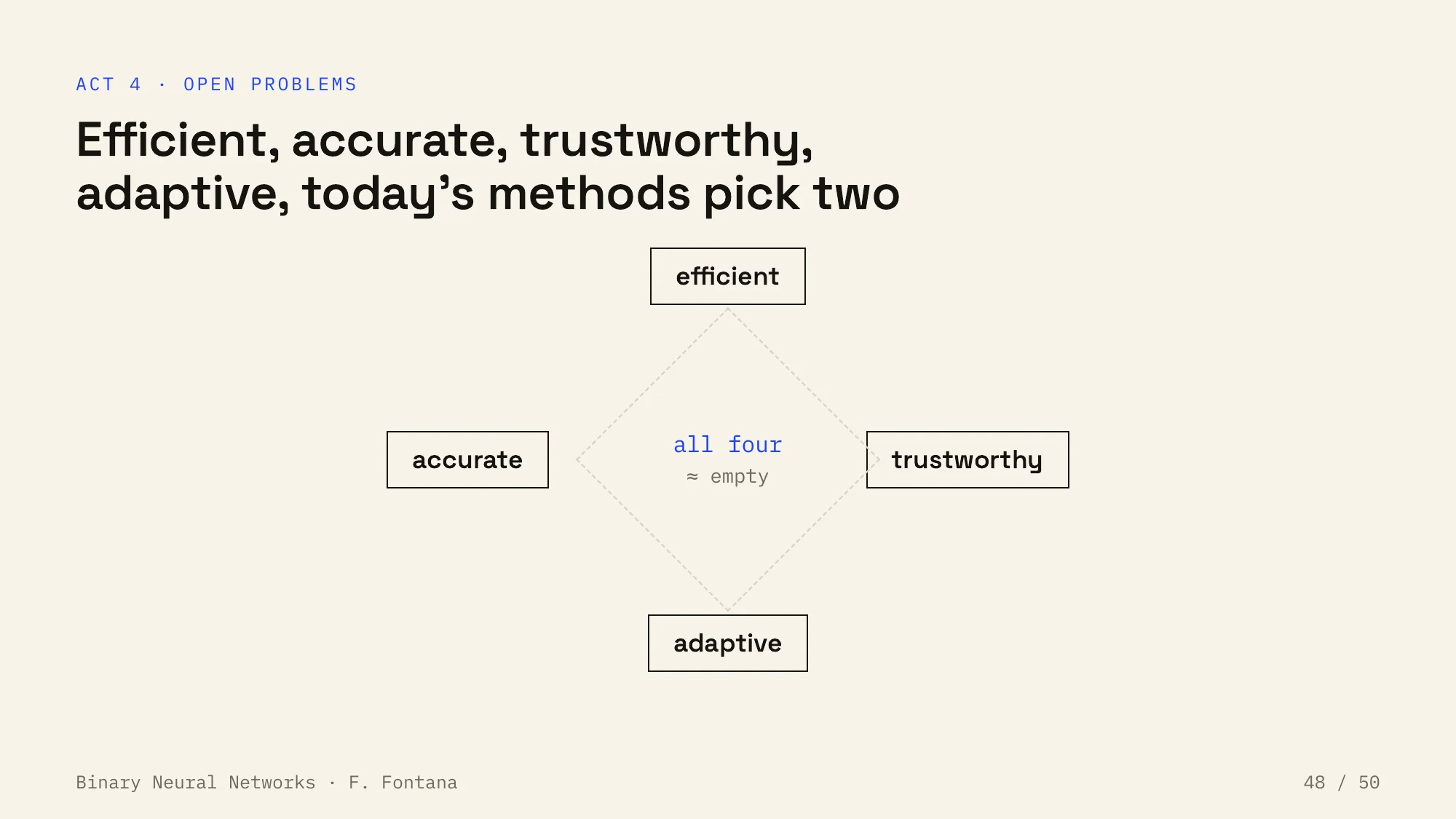
I make deep learning extremely efficient — compressing state-of-the-art networks into binary and low-bit forms that run where full-precision models cannot — and I ask whether what survives that compression can still be trusted: over time, under attack, and when a model must forget.

01 — About
I am a postdoctoral researcher at Sapienza University of Rome, where I earned my Ph.D. in efficient deep learning in January 2026 within the Computer Vision Laboratory. My work sits exactly where deep learning meets its hardware limits: I design networks that retain state-of-the-art accuracy while shedding the compute, memory and energy that modern models take for granted.
Two questions drive the work. First, how far can a network be compressed — binary and low-bit weights, structured pruning, distillation — before it stops working. Second, whether what survives that compression stays trustworthy: robust as the world shifts under it, able to spot synthetic media, and able to forget on demand.
I am first or sole author on the core efficiency methods, published at CVPR, ECCV, ICML and in Q1 journals including IEEE Transactions on Artificial Intelligence and the International Journal of Neural Systems. The work has been recognised with a Best Paper Award at ICVSS 2024, funded by competitive grants I hold as principal investigator, and released as open source that the community actually uses.
The collaborations are self-initiated and span nine countries — from a research visit I arranged myself in Klagenfurt to joint work with KTH, Imperial College London, Warwick, UAB Barcelona and others. I am always open to new ones, across academia and industry.
02 — Research
A single thread runs through all of them: getting more out of neural networks with radically less computation, memory and energy.
/ 01
Training networks that abandon floating point almost entirely — cyclic-precision schedules (CycleBNN), binary backbones for real-time perception, and quantization that survives deployment.
/ 02
Distilled gradual pruning with pruned fine-tuning: removing redundant structure while a teacher keeps the student honest, producing compact models for resource-constrained hardware.
/ 03
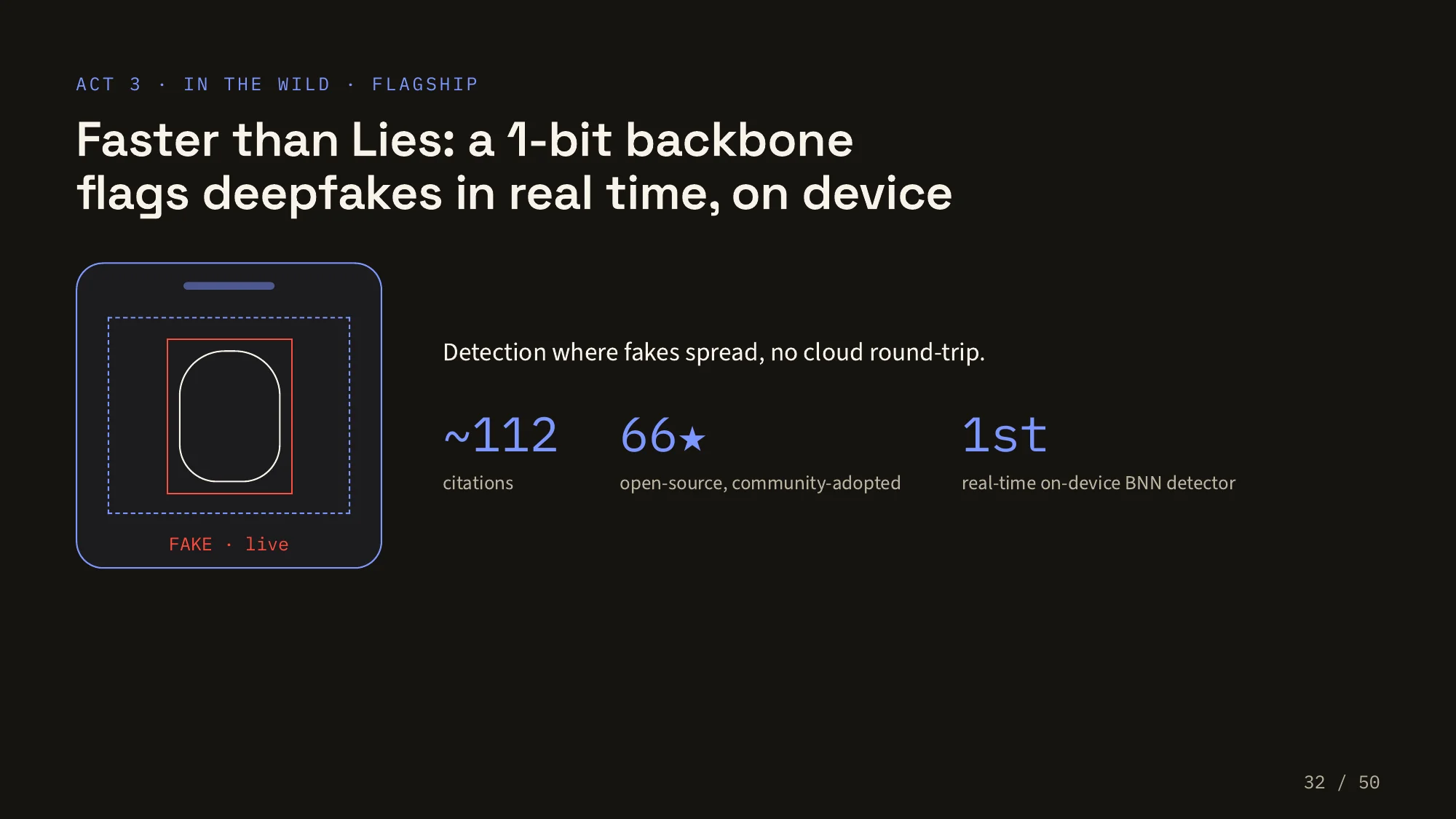
Real-time detection on binary backbones, plus a chronological continual-learning view of the problem that exposes how poorly detectors generalise to tomorrow's generators.
/ 04
A unified f-divergence framework for removing concepts from diffusion models — the efficiency lens applied to what a generative model should be able to forget.
/ 05
Matching drone, SAR and satellite imagery on board, under strict latency and power budgets — from an industrial internship at MBDA to BiCrossNet with the University of Klagenfurt.
/ 06
Transformer architectures for EEG: subject-aware emotion recognition (SATEER) and neural transcoding from EEG to fMRI (NT-ViT), with KTH and the University of Calabria.
03 — Experience
2026 — present
Sapienza University of Rome · Computer Vision Laboratory — Rome, Italy
2022 — 2026
Sapienza University of Rome · Computer Vision Lab — Rome, Italy
2024 · 3 months
University of Klagenfurt (AAU) · Klagenfurt, Austria
Self-initiated research visit on efficient cross-view geolocalization, resulting in BiCrossNet — a binary neural network approach published in Machine Learning: Science and Technology.
11/2022 — 04/2023
MBDA Italia · Aerospace & defence — Rome, Italy
Responsible for the cross-view geolocation algorithm matching SAR and RGB imagery, designed for real-time, low-power integration on board.
01/2019 — 06/2019
Soonapse · Agri-tech — Rome, Italy
Machine learning applied to water management in agriculture: data mining and predictive modelling for irrigation decisions.
01/2018 — 12/2018
Nextrek s.r.l. · Rome, Italy
Lead developer on mobile application development projects.
01/2016 — 12/2016
INFN — Istituto Nazionale di Fisica Nucleare · Frascati, Italy
Gathered requirements from research groups and built flexible WordPress plugins and PHP tooling so scientists could present their experiments online.
04 — Education
Jan 2026
Sapienza University of Rome · 2022–2026
Binarization, pruning and distillation for resource-constrained vision. Advisors: Prof. Danilo Avola, then Prof. Luigi Cinque.
Jul 2022
Sapienza University of Rome · LM-18
Thesis: Training binary neural networks without floating-point precision. Selected for the Department of Computer Science Path of Excellence.
05 — Publications
228 citations · h-index 6 · full and up-to-date list on Google Scholar.
2026
2026
2025
2025
2025
2024
2024
2024
2024
2024
2024
2024
2023
2023
Citation counts from Google Scholar, August 2026.
06 — Skills
07 — Contact
Open to collaboration on efficient deep learning across academia and industry — joint papers, research visits, student projects and industrial pilots.
fontana.f@di.uniroma1.it